How Donna and David found a home that works for their family
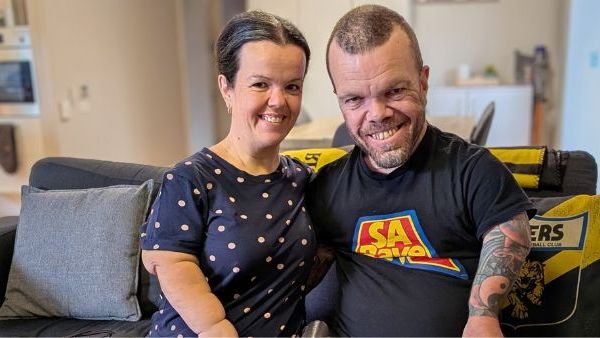
For Donna and David, finding an accessible home for their family wasn't straightforward. Despite having clear accessibility needs, their applications for Specialist Disability Accommodation (SDA) funding through the NDIS were unsuccessful. Today, they and their son Mason are enjoying family life in an accessible inhousing property that has given them greater independence, comfort and security. You can watch their video interview below.
Donna and David both have achondroplasia, a form of dwarfism that affects their height and mobility. Like many people with disability, they've spent much of their lives adapting to homes that weren't designed with their needs in mind.
Everyday activities, from preparing meals to reaching light switches or using the bathroom, presented challenges. As their needs changed over time, finding a home that was safe, accessible and suited to their family became increasingly important.
"We always used to say, before we got older, that we adapt. The world doesn't adapt to us. We adapt to the world," Donna explains.
"But as time's getting on… it needs to be reverted the other way. Now the world needs to start adapting to us."
When SDA funding isn't approved, the need for accessible housing remains
Donna and David have been through the process of applying for SDA funding through the NDIS on several occasions. The experience was particularly frustrating because although their family had clear accessibility requirements and provided detailed assessments and evidence, their applications were unsuccessful.
"We all have our different needs," David explains. "And when they say we're not enough, that kind of puts us on the back foot with going, well, what is enough?"
The experience left the family uncertain about their housing options.
For people with disability, an unsuccessful SDA application doesn't mean their need for accessible housing disappears. Nor does it change the practical barriers they face when living in a home that isn't suited to them.
While some of our homes are available to people with approved SDA funding, we also work with people who have demonstrated accessibility needs but have been declined SDA funding, or who may be eligible and are still awaiting a decision.
Our focus is on understanding each person's circumstances and exploring whether we have an appropriate housing option to meet their needs.
Finding a home that fits
With the help of their support coordinator, Donna and David were looking for a more suitable place to live when they connected with inhousing.
David describes that moment as a turning point.
"When inhousing reached out to us, it was like a silver lining around a dark cloud," he says.
Their new home offered something that had been missing from their previous accommodation: a space designed with accessibility in mind.
Features such as wider doorways, generous circulation spaces, accessible bathrooms and easier access throughout the property have made a noticeable difference.
David, who uses a wheelchair, can move around the home without worrying about damaging doorframes or walls. Donna appreciates how much easier it is to navigate the space with mobility aids.
Their accessible home has reduced some of these practical barriers, allowing them to spend less time working around their environment and more time enjoying it.
The freedom to enjoy everyday family life
For Donna and David, the benefits of accessible housing go well beyond physical features. Their new home has provided a greater sense of safety and the freedom to enjoy everyday activities that many people take for granted.
Donna describes how having an accessible bathroom in their new home means she can shower safely and comfortably.
The layout also makes it easier for David to leave the house independently using his wheelchair, without steps or other barriers getting in his way.
The family now enjoys welcoming friends into their home, including friends who also use mobility aids.
"We like having people here now," David says.
For their son Mason, the move has also provided a spacious home where he has room to grow and enjoy family life.
David describes it as a "forever house", somewhere the family can imagine staying for the long term.
And for Donna, perhaps the biggest difference is the feeling of being settled.
"When you go out, you've got that feeling, 'Oh, I just want to go home.' And this has actually become a safe space."
A supportive landlord makes a difference
Having a suitable home is only one part of the family's positive experience. Donna and David also value their relationship with inhousing as their landlord.
Donna recalls how their property manager took the time to sit and chat with them during an inspection, rather than simply checking the condition of the property and leaving. She has also appreciated the responsiveness to maintenance requests and the willingness to consider changes that help make the property feel like their own.
For Donna, the difference between inhousing and other landlords comes down to something simple.
"They're not only concerned for their property, but they're also concerned for the people that are in the property."
Accessible housing should be about people, not just funding
Donna and David's experience shows what can happen when housing is matched to a person's needs. Their home has made everyday activities easier, supported their independence and provided the space and security to enjoy life together as a family.
Most importantly, they have a place where they feel comfortable, welcome and in control of their home life.
Every person's circumstances are different, and housing options depend on individual requirements, property suitability and availability. But we believe the conversation shouldn't end with an unsuccessful funding decision.
For Donna, David and Mason, finding the right home has changed what everyday family life looks like.
Looking for accessible housing?
If you or someone you support needs accessible housing, inhousing can discuss your needs and help you understand whether one of our properties may be suitable.
Contact inhousing at intake@inhousing.org.au to explore your options.
Donna and David talk to inhousing about their housing experiences and what it meant for them to find their ideal home with inhousing.